Standing Before a Locked Door: The Zen Koan That Teaches the Wisdom of Waiting
What can we learn when standing before a locked door? Explore the Zen koan paradox: sometimes the door opens only when you stop pushing.
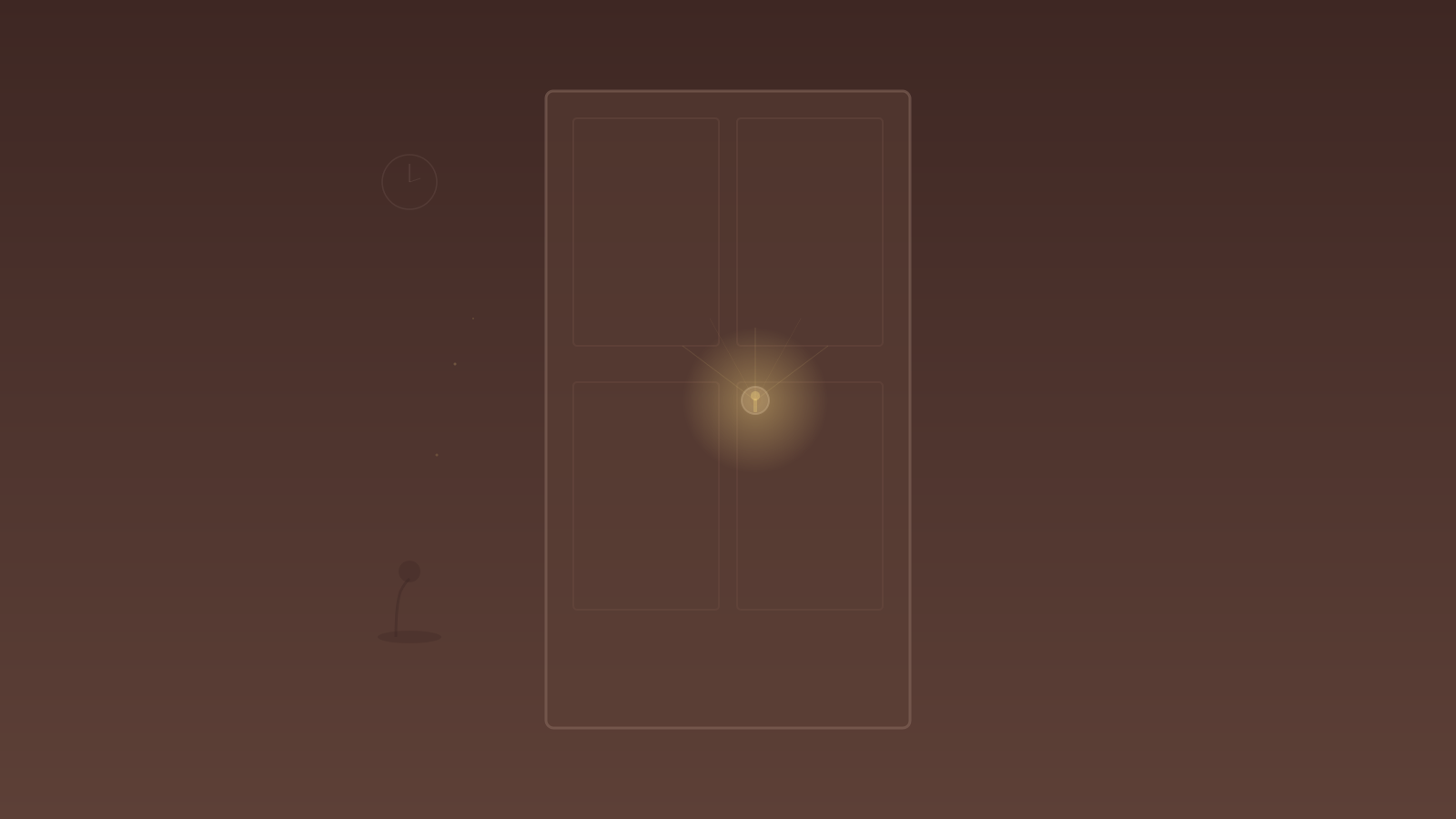
The True Nature of Endless Knocking
From childhood, we are taught that effort is always rewarded. So when a door won't open, we push ourselves harder. But from a Zen perspective, this 'more' is the very root of suffering. The harder we knock, the greater the gap between our effort and the unyielding reality, and frustration swells. Psychology calls this the 'ironic process theory'—Harvard researcher Daniel Wegner showed that the harder we try to suppress a thought, the more forcefully it returns. The harder we try to sleep, the more sleep eludes us. Zen saw through this paradox over a thousand years ago.
The Gateless Gate, compiled by Master Wumen, offers the teaching of 'a gate that is no gate.' There was never a barrier to pass through; the barrier was an illusion created by our own minds. The locked door of a job, a relationship, or a promotion may also be a phantom, sustained only by our conviction that 'I must go through here.' It is not the door itself, but the meaning we attach to it, that keeps us trapped.
The Locked Door as a Koan
Zen koans are tools that use questions unsolvable by logic to halt discriminating consciousness itself. In the Blue Cliff Record, Case 46, Master Jingqing asks a monk, 'What is that sound outside the gate?' The monk answers plainly, 'The sound of raindrops.' Classical Zen commentaries contain the line 'sentient beings, upside down, lose themselves and chase after things,' sharply naming the inversion by which we lose the self and pursue external objects. The koan does not deny the rain; it points out how, the instant we label 'raindrops,' we split self from sound and let awareness leak outward. The locked door works the same way. The moment we flip the question from 'How do I open it?' to 'Who is this person standing before the door?', the door ceases to be an enemy and becomes a mirror.
Zen Master Hakuin taught, 'Great doubt, great awakening.' The courage to stay with doubt—rather than flee from it—is the gateway to insight. This resonates with modern Acceptance and Commitment Therapy (ACT), where meta-analyses consistently show that accepting unwanted feelings, rather than fighting them, produces measurable improvements in anxiety and depression.
The Practice of Simply Standing
To stand before the door in a koan-like way means to stop trying to open it and simply be there. This is not resignation. Resignation turns its back on the door. Simply standing means facing the door while releasing attachment to the outcome, accepting yourself as you are right now. When you stop pushing, you begin to notice your surroundings. You might see another path, realize you never needed to go through, or discover the door was meant to be pulled, not pushed.
Try the 'three-minute pause.' When you feel stuck, set a timer for three minutes and sit. Don't check your phone, don't organize your thoughts, don't search for solutions. Just observe your breath and the tightness in your chest. Many find these three minutes feel endless, yet afterward a strange spaciousness appears. Neuroscientifically, the brain shifts into default-mode network activity, where diffuse thinking emerges. Like Archimedes in his bath, insights arrive when we stop searching.
Releasing the Door Through the Body
Frustration lives in the body, not the mind. Shoulders rise, jaws clench, breath shortens. Thinking from this state only makes the door seem more immovable. This is why Zen training begins with posture and breath. Plant both feet on the floor, lengthen the spine, inhale for six seconds and exhale for eight. Ten rounds activate the parasympathetic nervous system, measurably lowering heart rate and blood pressure.
When the body softens, the mind gains space. With space, we can quietly ask, 'Is this really the door I must pass through?' Dogen called this 'shinjin datsuraku'—the dropping away of body and mind. True freedom appears the moment fixation loosens. And stepping physically away helps too: walking, bathing, washing dishes. A Stanford study found that walking boosts creative output by roughly sixty percent over sitting. When stuck before a door, put on your shoes and step outside. It is the most Zen, and the most scientific, first step.
Meeting Locked Doors in Daily Life
When you feel stuck, try four steps. First, breathe deeply three times and release physical tension. Second, ask 'What am I trying to open?' and write the door's name on paper. Third, go deeper: 'What am I truly seeking beyond this door?' Usually, the answer is not the object itself but a deeper longing—to be recognized, to feel safe, to be free. Fourth, ask, 'Is there a way to fulfill that longing right now, on this side of the door?'
For someone suffering over a failed job search whose deeper wish is 'to feel valued,' writing down small daily contributions at their current workplace may heal more than any new position. Doors are many, and paths to our longings are limitless. Edward Deci's self-determination theory confirms that human flourishing arises not from external achievements but from the inner needs of competence, autonomy, and relatedness. The treasure we imagined behind the door may already be on our side.
Another helpful practice is to keep a 'list of doors that never opened' in your journal. Write down the doors you abandoned or were refused over the past five years, and beside each one, note the good things that happened instead. Many people discover an uncanny correspondence between the doors that closed and the new encounters that followed. This is not wishful thinking but a way to visualize the Buddhist teaching of dependent origination—the reality that every event arises within a web of relationships. What looked like a refusal was often an opening in another direction we could not yet see.
The Gift a Locked Door Offers
Looking back, many people realize that today's life exists because certain doors refused to open. The mentor met after rejection from a first-choice school, the partner found after heartbreak, the career built from the ashes of a closed business. Doors don't merely shut—they gently redirect us toward a path we could not have imagined.
Zen offers the phrase 'yanagi wa midori, hana wa kurenai'—'the willow is green, the flower is red.' Things are most beautiful exactly as they are. A life spent prying open every closed door is different from a life that meets opened and closed doors with the same steady gaze. In the latter there is no winning or losing, no success or failure, only the quiet of living this one day sincerely. This is the everyday version of sitting with a koan. Don't rush the answer; sit with the question a while longer. Answers don't come from logic; they arrive, unbidden, when the question has fully ripened. A locked door is not an enemy. It is Zen's invitation, handwritten and delivered to your doorstep, asking you to return to the here and now.
About the Author
Zen Insightful Editorial TeamWe share Zen teachings in a way that is easy to understand and applicable to modern life.
View author profile →Related Articles
What the Evening Breeze Teaches About Zen: How Wind on Skin Returns You to the Present
Letting Go of Past Glory: How Zen Teaches You to Free Yourself from Who You Used to Be
The Zen Focus of Slow Reading: Savoring Each Line in the Age of Speed Reading
The Courage to Let Go of Control: How Zen Teaches Us to Embrace What We Cannot Change