What Weeds Teach Us About Zen: The Wisdom of Resilience in Everyday Life
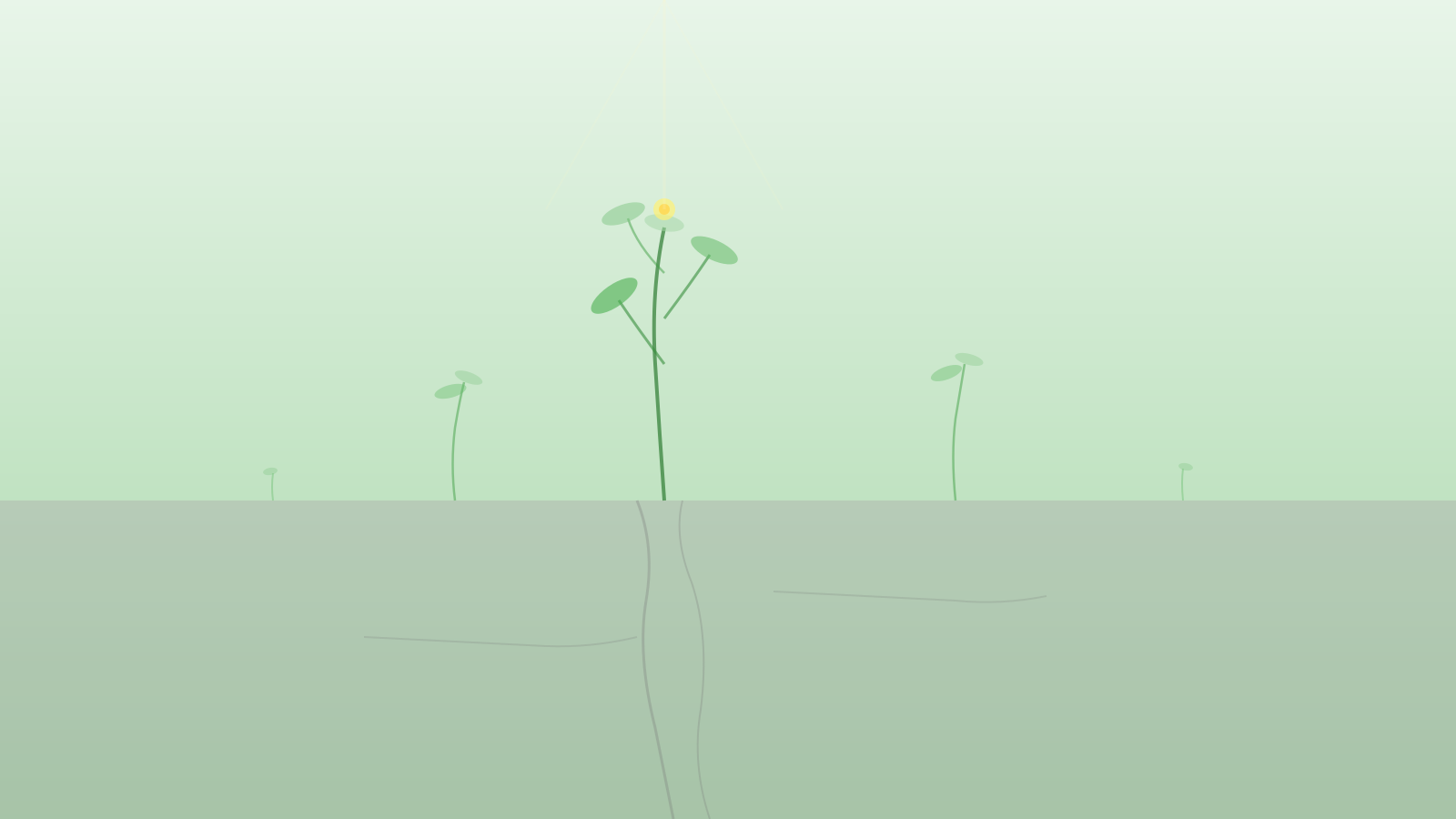
Weeds push through cracks in concrete with quiet determination. Zen sees in their resilience a profound teaching about living without pretense and blooming wherever life places you.
Three Lessons from Weeds: Don't Choose, Don't Compare, Don't Give Up
The first lesson weeds teach us is to stop choosing your conditions. Weeds take root in asphalt cracks, between stone walls, in the thin soil of drainage gutters—anywhere they land. We humans spend enormous energy wishing for ideal circumstances, but Zen teaches zuisho ni shu to nare—'wherever you are, be the master there.' This phrase, recorded in the Record of Linji, calls us to live as the protagonist of our lives no matter where we stand. A weed embodies this perfectly. It gives everything to the place it has been given, without blaming its environment for any shortcomings.
The second lesson is to stop comparing. A weed never envies the beauty of a rose or feels inferior to a towering oak. It simply blooms its own flower and scatters its own seeds. There is a Zen saying: 'The willow is green, the flower is red.' Each thing is complete as itself. Comparison, Zen tells us, is a root of suffering. Psychologist Leon Festinger's social comparison theory confirms this: upward comparisons consistently lower self-esteem and deepen depressive mood. When we pour our full energy into simply being ourselves—like a weed—our original brightness returns.
The third lesson is to never give up after being stepped on. A weed falls flat when trampled, but by the next morning, it has raised its stem again. This is not rigid resistance but flexible acceptance followed by rising once more. Psychologists call this capacity resilience, and recent positive psychology research names it among the most critical traits for overcoming adversity. In Zen training, practitioners nod off during zazen, hit dead ends with koans, and experience setback after setback. Yet each time, they straighten their posture, settle their breathing, and sit again. Falling is not the problem. Rising again is the essence of practice.
The Selflessness of Nameless Grass: Weeds and Zen's Teaching of No-Self
Ask a weed its name and you will receive no answer. Humans lump them together under the label 'weeds,' yet each individual plant is a distinct life. The saying 'There is no plant called a weed,' traditionally attributed to Emperor Showa of Japan and also associated with the renowned botanist Tomitaro Makino, captures this truth. Annual meadow grass, broadleaf plantain, fleabane, daisy fleabane—each carries its own name and ecology. This truth resonates deeply with Zen. By labeling and categorizing, we lose sight of the unique light each being carries.
A weed holds no self-concept of being a weed. It has no fame, no title—it simply lives. Zen regards this state of mushin—no-mind—as the most precious of all. For modern people trapped by the question 'Who am I?' and constantly defining themselves by titles and evaluations, the weed's unselfconscious existence is Zen in its purest form. A flower blooms without a name. Life shines without recognition. Perhaps we, caught up in counting likes on social media, have forgotten how to exist as quietly as a weed.
On your next walk, look down at the weeds beneath your feet. Crouch beside a single stem pushing through a crack in the pavement and gaze at it closely. The veins of its leaves, the curve of its stem, the faint gleam along its edges. When you notice this small life—choosing nothing, comparing nothing, giving up on nothing, claiming no name—simply living with all its might, something quiet and powerful begins to stir in your own heart. This is not mere sentimentality. Research by Professor Yoshifumi Miyazaki at Chiba University has shown that observing plants activates parasympathetic nervous system activity and reduces heart rate and salivary cortisol levels. Gazing at a weed is, scientifically, an act that restores body and mind.
The Soft Strength of Plantain: Turning Being Trampled Into a Strategy
The broadleaf plantain, common along roadsides, is a fascinating plant. When its seeds become wet, they exude a gelatinous mucus that sticks to human shoes and animal feet, allowing them to travel. In other words, plantain chooses places where it will be trampled, using the act of being stepped on as its very strategy for dispersing seeds. In untrampled spots it actually loses out to other plants in competition. It has turned adversity into the engine of its survival.
Zen training follows a similar pattern. Practitioners deliberately choose harsh conditions with no escape, using that rigor to polish the mind. In a monastic hall, monks rise at three-thirty, wash in cold water, eat simple food, and sit for long hours of zazen—deliberately placing themselves in difficult circumstances. The great Zen master Hakuin said, 'Beneath great doubt lies great awakening.' It is precisely under major questions and struggles that deep insight arises.
In the business world, Kazuo Inamori, founder of Kyocera, taught that hardship is the whetstone that polishes the human being. He made accepting adversity as an opportunity for growth the core of his philosophy. Rather than hating being trampled, grow because you are trampled—plantain's wisdom quietly invites us to rethink how we relate to work, setbacks, and life itself.
The Courage to Release: What Dandelion Seeds Teach Us
When a dandelion's flower finishes blooming, it becomes a sphere of downy seeds and entrusts itself to the wind. It does not know where it will land. It does not choose its soil. It simply flies wherever the air carries it. This is the Zen teaching of hoge jaku—'put it down.' In a famous koan, a monk told Master Zhaozhou, 'I have nothing.' The master replied, 'Put it down.' Release even the idea of having nothing—that is the total abandonment of attachment.
We grip our plans tightly, anxious about the future, trying to control outcomes. But like a dandelion, we can do our best and then surrender the result to the wind. This stance lightens the heart. A body of research by Professor Ellen Langer of Harvard suggests that a mindful state, in which one releases the need to control, may be associated with favorable effects on stress hormone levels and immune function, and more broadly with improvements in indicators of physical and mental well-being.
To fly, a seed must be light. To rise into something new, we too must let go. Past failures, others' opinions, perfectionism, the image of who we think we should be—releasing them one by one, we find new flowers blooming in places we never expected.
Living Like a Weed: Three Practices for Daily Life
The first practice is to put down roots where you are. The urge to change jobs, move houses, or reshape relationships is natural. But first, ask whether you have truly rooted yourself where you stand now. When you arrive at work each morning, take one deep breath and silently say, 'This is my place.' It can be on the commuter train or at your own front door. In that moment, gratitude begins to replace dissatisfaction. Try it for two weeks and you will notice the same environment feels different.
The second practice is to straighten your posture the morning after being stepped on. After a failure at work or a wound in a relationship, treat the first five minutes of the following morning as sacred. Stretch your spine while still in bed, take three deep breaths, and rise. In front of the mirror, lift the corners of your mouth slightly, open your shoulders, and stand tall. Like a weed lifting its stem the day after being trampled, start with the body. The mind will follow. The "power pose" research by social psychologist Amy Cuddy once drew wide attention, though later replication studies have suggested that the hormonal effects are limited and the findings should be treated with caution. Even so, the felt sense that adjusting posture can shift our mood is widely shared, and starting with the body remains a practical way to rebuild the heart.
The third practice is to perform one nameless act of kindness. Do something small for someone in a place where no one will notice. Pick up litter, hold a door, listen to someone's story all the way to the end, be the first to greet. Just as a weed blooms unseen, an act without expectation of reward lightens the heart. Like the Zen spirit of samu—work as practice—the deepest cultivation happens in acts that carry no name. Professor Sonja Lyubomirsky at UC Riverside found that participants who performed five acts of kindness a week for six weeks showed significant increases in happiness.
Live like a weed, pouring yourself fully into this moment. Don't choose. Don't compare. Don't give up. Let go. Claim no name. That is Zen's simplest and most powerful practice. Tomorrow morning, as you step outside, look down at your feet. Your teacher is already there.
About the Author
Zen Insightful Editorial TeamWe share Zen teachings in a way that is easy to understand and applicable to modern life.
View author profile →Related Articles
The Zen Art of Delegating: Why Letting Go of Control Makes Work Flow Better
Awakening to the Moment of Waking: What Zen Teaches About the Hidden Truth Between Sleep and Awareness
Choose One Tree and Watch It Daily: The Zen Practice of Fixed-Point Observation
Are You the Same Person You Were Yesterday? The Zen Koan That Breaks 'I Can't Change'