The Finger Pointing at the Moon: How Zen Frees You From Obsessing Over Methods and Returns You to What Matters
The harder you chase the right method, the more you lose sight of what matters. From the Zen parable of the finger pointing at the moon comes a wiser way to live.
The Harder You Search for the 'Right Way,' the More It Hurts
You set out to start meditating, but first you spend hours researching the 'correct breathing technique' and the 'best app'—and the night ends without your ever once sitting down. You want a book to change your life, but you stay up late scrolling through rankings of 'which book to read first.' Does any of this sound familiar?
Whenever we try to take something seriously, we unconsciously begin hunting for the 'right method.' Yet the more frantically we try to perfect the method, the further we drift from the very thing we wanted to reach. The means ends up eclipsing the goal. Zen has a teaching that names this trap with striking clarity: the parable of the finger pointing at the moon.
The Finger and the Moon: A Parable Zen Returns To Again and Again
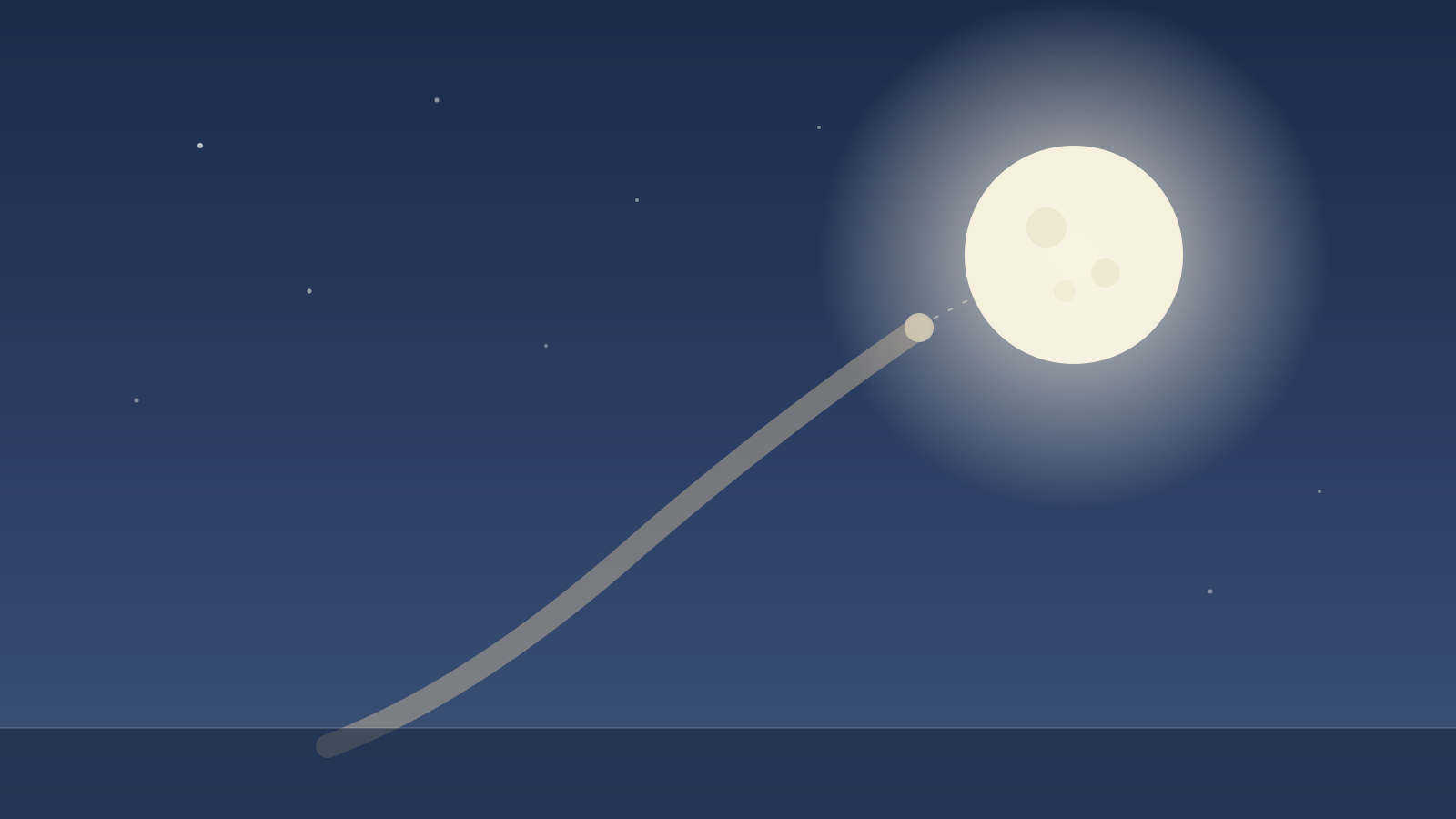
Suppose someone points at the moon in the night sky and says, 'Look, see that moon.' But what if the other person stares only at the finger and starts saying, 'What a beautiful finger,' 'It's the angle of this finger that is correct'? The finger exists to show the moon, yet they are not looking at the moon at all.
This parable appears in the Lankavatara Sutra, one of Zen's foundational texts, and has been used repeatedly by later Zen teachers. The finger represents 'words,' 'teachings,' and 'methods'; the moon represents 'truth' and 'what truly matters.' Scriptures, a teacher's words, the forms of seated meditation—all of these are merely 'fingers' pointing at the moon. They are not, themselves, the moon. That is the warning.
There is a reason Zen prized this parable so highly. Buddhism carries a vast body of scripture and doctrine, yet Zen taught the principle of 'not relying on words and letters'—do not barricade yourself behind text and logic. Words are signposts, nothing more, and as long as you keep clutching the words, you will never reach what lies beyond them. Do not mistake the finger for the moon.
Why We Become Fixated on the 'Finger'
The moon itself is elusive and hard to describe. The finger, by contrast—the method, the know-how—is visible, concrete, and gives an easy sense that effort is being made. So we naturally become absorbed in the more graspable finger.
The reassurance of 'I'm following the correct steps,' 'I chose the popular method,' feels pleasant. But while we bask in that reassurance, the thing we are really meant to taste, the place we are meant to arrive, stays untouched and abandoned. Collecting methods quietly turns into the goal itself.
Today this trap runs deeper than ever. Precisely because we live in an age where searching yields endless 'right answers,' we compare finger after finger without limit, forever seeking the optimal finger, while the day ends without our ever once looking up at the moon. Here is the paradox: the more information grows, the further we drift from the essence.
The Nun Who Saw the Moon: A Story of Huineng
Zen preserves an anecdote that seems to live out this very parable. It concerns Huineng, the Sixth Patriarch and one of the most revered figures in Zen history. Huineng, it is said, could not read. One day a nun named Wujinzang asked him about a passage of scripture. When Huineng fluently explained its meaning, the nun was astonished: 'You cannot even read the characters—how can you understand the meaning of the scripture?' Huineng is said to have answered, 'Truth is like the moon. The written words are merely a finger pointing at that moon. To see the moon, the finger is not strictly necessary.'
What this story conveys is not that words and knowledge are useless. Huineng too left behind many words. But he did not mistake the finger of text for the moon itself. He clearly distinguished being able to trace the finger from actually seeing the moon. The famous quotes we copy into our planners, the number of bookmarks we save, are never proof that we have 'seen the moon.' As long as we are competing over the number of fingers, perhaps we have not yet looked up at the night sky at all.
What I Noticed on a Night When My Work Stalled
There was a night when I was stuck while preparing a document. I should have been thinking about 'how to write so it gets through,' but before I knew it I had spent hours hunting for software features and slick-looking templates. Changing fonts, tidying the layout—it felt like work. Yet the actual content on the screen, what I wanted to convey, had not advanced by a single word.
I stopped and realized: I had been polishing the tool that points at the moon—the finger of a template—while never once looking up at the moon itself. I closed the tool, took a blank sheet of paper, and wrote a single line: 'In the end, what am I trying to say with this?' From there, everything flowed. The moment I stopped searching for a finer finger, I finally began walking toward the moon.
Practices for Letting Go of the Finger and Seeing the Moon
The wisdom of this parable can serve us in many everyday situations. Here are three practices.
First, before starting anything, write in one line 'what I really want to gain from this.' For meditation, 'I want to quiet my mind'; for reading, 'I want to deepen my thinking.' That single line is your 'moon.' Whenever you get lost among methods, return to it, and you will no longer be jerked around by the finger.
Second, do not use 'once I find the perfect method' as a reason to delay. You do not need to wait for the finest finger to see the moon. With the imperfect finger you have now, simply look up in the direction it points. Even if your posture is clumsy, sit first. A clumsy first step is far closer to the moon than perfect preparation.
Third, do not clutch a method that worked as 'the one and only right answer.' A finger that led one person to the moon may not work for another person or another situation. A finger is something to use according to circumstances. The moment you cling to a single method, it becomes yet another 'finger to be stared at.'
Even a Teacher's Words Are Not the Moon
What makes this parable so sharp is that it is aimed not only at 'other people's know-how' but at 'a teacher's teaching' and 'precious words' as well. A Zen teacher imparts teachings to a disciple, yet at the same time warns, 'Do not cling to my words.' However noble a teaching may be, it is a finger pointing at the moon, not the moon itself.
This is exactly why the finest Zen monks disliked having their words worshipped by disciples as absolute law. To memorize and quote a teaching, and to stand for oneself in the state that teaching points to, are entirely different things. You may gather hundreds of borrowed fingers, but unless you look up at the moon with your own eyes, the night sky will not brighten.
The same applies to us perfectly. Even if you collect others' famous sayings and become able to discuss superb methodologies, if you are not living them, you are merely holding a collection of impressive fingers. What matters is not being able to talk about it, but actually looking up beyond it and walking.
Tonight, Look Up at Your Own Moon
What the parable of the finger pointing at the moon finally asks is something very simple. Right now, are you looking at the finger, or at the moon?
Refining methods, increasing knowledge, searching for the right way—none of these are bad in themselves. They are simply fingers that point at the moon, and at some point you must take your eyes off the finger and look up, with your own eyes, at the very direction it indicates.
When you hit a wall, when you grow weary in the sea of information, pause and ask yourself: 'Am I looking only at the finger right now?' That question will gently open the clenched hand and quietly lift your gaze toward the moon you wanted to see all along.
About the Author
Zen Insightful Editorial TeamWe share Zen teachings in a way that is easy to understand and applicable to modern life.
View author profile →Related Articles
Taking a Different Way Home Changes the World: Zen's Beginner's Mind in Daily Life
When Reconnecting Feels Awkward: A Zen Approach to the Gap of Time Between People
When Waiting at a Crosswalk Becomes Meditation: A Zen Way to Return to Now
What Loss Finally Lets You See: The Zen Teaching of Emptiness in Grief