Has Anyone Seen the Moment Water Boils? A Zen Koan on the Illusion of Boundaries in Change
When exactly does water become boiling water? This Zen koan dissolves our obsession with pinpointing the moment of change and frees the mind.
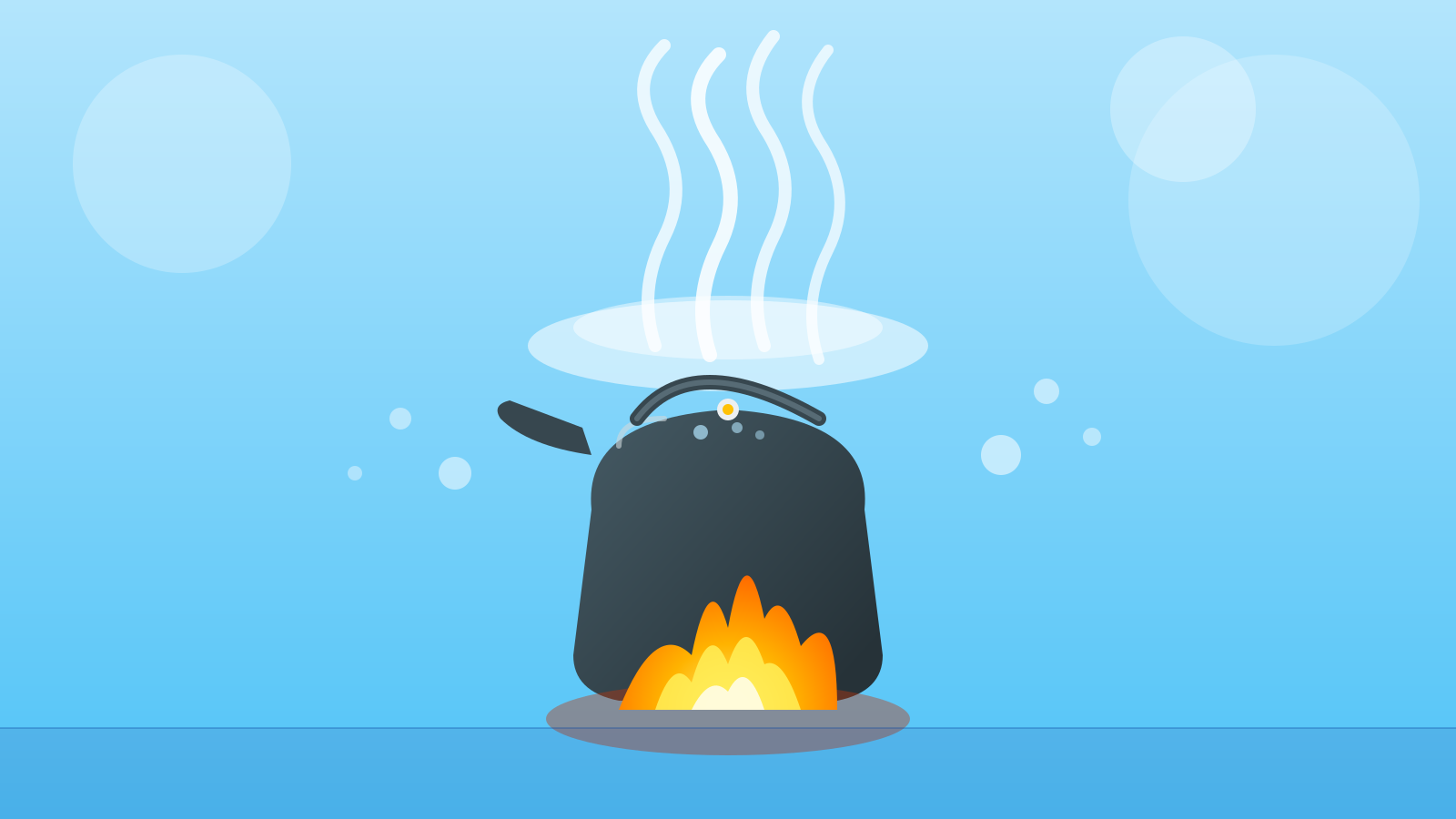
How the Illusion of Boundaries Creates Suffering
Whenever we talk about change, we demand a 'when.' When did I become an adult? When did I get comfortable at this job? When did I fall in love? In reality, change is always continuous. There are no stages in heating water—molecules simply move a little more vigorously from moment to moment. The 'moment it becomes boiling' is merely a line our thinking draws for convenience. Zen takes issue with our attachment to these convenient lines. By drawing boundaries we feel we understand the world, but those same lines become sources of suffering. 'I haven't succeeded yet.' 'I'm no longer young.' Every such judgment is the result of imposing artificial boundaries on continuous change.
Cognitive science tells us the human brain compresses information through categorization. Eleanor Rosch's prototype theory at UC Berkeley showed that we perceive the world through 'typical examples' and 'exceptions.' While useful for quick decisions, this process tricks us into believing the lines are real. Zen koans are quiet devices designed to loosen that illusion.
Where the Physics of Boiling Meets Zen
In physics, boiling occurs when saturated vapor pressure equals atmospheric pressure. Strictly speaking, 100°C applies only at one atmosphere; at the altitude of Mt. Fuji's summit (around 3,776 m) water boils near 87°C. Even the 'common sense' of 100°C is a relative line depending on conditions. Microscopically, the first bubbles form only because of 'nucleation sites'—tiny scratches or impurities. Water with few impurities can exhibit 'superheating,' remaining liquid a few degrees above the expected boiling point.
Knowing this, the boundary of 'the moment of boiling' grows even more ambiguous. Atmospheric pressure, container surface, water purity, and heat transfer all conspire to produce what we call boiling. The koan-like question 'Has anyone seen the moment water boils?' lets us feel this truth intuitively rather than logically. Where science proves and Zen embodies, we glimpse the true face of change.
Sitting with the Koan: A Three-Minute Practice
Try placing the question 'Has anyone seen the moment water boils?' in your mind as a koan-like inquiry. You don't need to produce an answer—in fact, the inability to answer is the point. Logic might suggest 'the moment it reaches 100 degrees,' but that's a line drawn by a thermometer. The water itself knows no such line. It simply exists, moment by moment, in a state slightly different from the one before.
Here is a concrete method. First, prepare a transparent pot or kettle with about 500 ml of water. Second, light the flame, set a three-minute timer, and stay—watching only the surface and the bottom. Third, consciously avoid silently labeling 'not yet' or 'already.' Fourth, receive the faint sounds, the first bubbles, and the rising steam simply as phenomena. Over three minutes of continuous observation, you will notice how deeply your thinking depends on dividing. Good and bad, success and failure, beginning and end—Zen koans shatter these binaries and cultivate eyes that see the world before it is divided.
What Neuroscience Says About Letting Go of Boundaries
Mindfulness pioneer Jon Kabat-Zinn has reported that attention to the continuity of change calms the overactive amygdala. Harvard's Sara Lazar found that eight weeks of mindfulness practice thickens the prefrontal cortex and improves emotional regulation. Clinging to 'not yet' and 'already' is a high-cost state for the brain.
Continuous observation—like watching water come to a boil—halts the loop of judgment and quiets the overactivity of the default mode network. It approaches the flow state described by Mihaly Csikszentmihalyi: a silent absorption. I personally make it a habit, when deadlines pile up, to deliberately boil water and watch for three minutes. By the time the coffee is poured, my breathing has deepened and my judgments have softened. Both scientifically and experientially, time spent releasing boundaries restores the mind.
A Practice for Releasing the 'When' of Your Life
Turn the few minutes of waiting for water to boil into a small daily Zen practice. Place the kettle on the flame and stay. Watch the initial stillness, the faint sound, the bubbles forming at the bottom, and the full boil. Instead of splitting this into 'not yet' and 'already,' simply observe each moment as it arrives. Something curious happens: the mind grows calm, because there is no longer any need to rush between 'not yet' and 'already.'
Life is the same. When you anxiously think 'I haven't grown enough' or despairingly believe 'it's too late,' you are simply suffering from a boundary line you drew yourself. Career changes, marriage, raising children, recovering health—none of them can be pinned to a single 'when' without pain. Looking back, change is always a quiet accumulation of small choices and events, with no clear line anywhere. Watch your own change the way you watch water boil—with a quiet, steady gaze. In that stillness lies the deep peace that Zen teaches.
Three Questions to Begin Today
Finally, here are three concrete questions for weaving this koan into daily life. First, 'What boundary lines am I suffering from?' Write down the lines of age, title, and achievement that you impose on yourself. Second, 'Who drew those lines?' Society, family, a past self, or an external tool like a thermometer. Knowing the source shakes their apparent absoluteness. Third, 'How would this moment feel if I drew no line?' A naked present, stripped of evaluation, will appear before you.
Ask these three questions once a week while boiling water. A koan is not something to solve with the mind but something to soak into daily life. Within the continuity of water becoming steam, your own transformation is also dissolved. Only when you stand in a world without boundary lines can you rest safely in the here and now.
Dogen wrote in the Shobogenzo that firewood becomes ash, yet firewood does not 'turn into' ash—firewood has its own Dharma position, ash has its own. There is no 'moment of change': each moment is complete in itself. Water, steam, before boiling, after boiling—each instant is whole. From this view, every moment of your life is not a waypoint but a completed reality. The you who is failing, the you who is lost—you are not mid-journey toward completion; you are already whole in this very instant.
Tonight, in your steam-filled kitchen, you may stand before the kettle again. Pause for a moment and ask, 'When did it boil?' The unanswerable question will release you from evaluation and urgency, guiding you into a quiet present. Zen koans are not distant wisdom from a thousand years ago; they are living teachings, breathing each morning inside your kettle. If you are suffering tonight from 'not enough' or 'too late,' try boiling water once for tea. Put down the phone, forget about the timer until it rings, and focus only on the surface. Those three minutes will produce no output, yet something will settle in your heart. You cannot pinpoint the boiling, and yet, somehow, tea time has arrived—that very experience is the answerless answer of the koan.
About the Author
Zen Insightful Editorial TeamWe share Zen teachings in a way that is easy to understand and applicable to modern life.
View author profile →Related Articles
Watching Your Own Shadow: How Zen Awareness Teaches You to Dialogue with Your Other Self
Standing Before a Locked Door: The Zen Koan That Teaches the Wisdom of Waiting
What the Evening Breeze Teaches About Zen: How Wind on Skin Returns You to the Present
Letting Go of Past Glory: How Zen Teaches You to Free Yourself from Who You Used to Be