Listening to a Child's 'You Know What...' All the Way Through: How Zen Teaches Us to Be Fully Present With the Person in Front of Us
Do you half-listen to your child or family while doing something else? From the Zen idea of nikon—this very moment—comes a way of listening that gives your whole heart to the person before you.
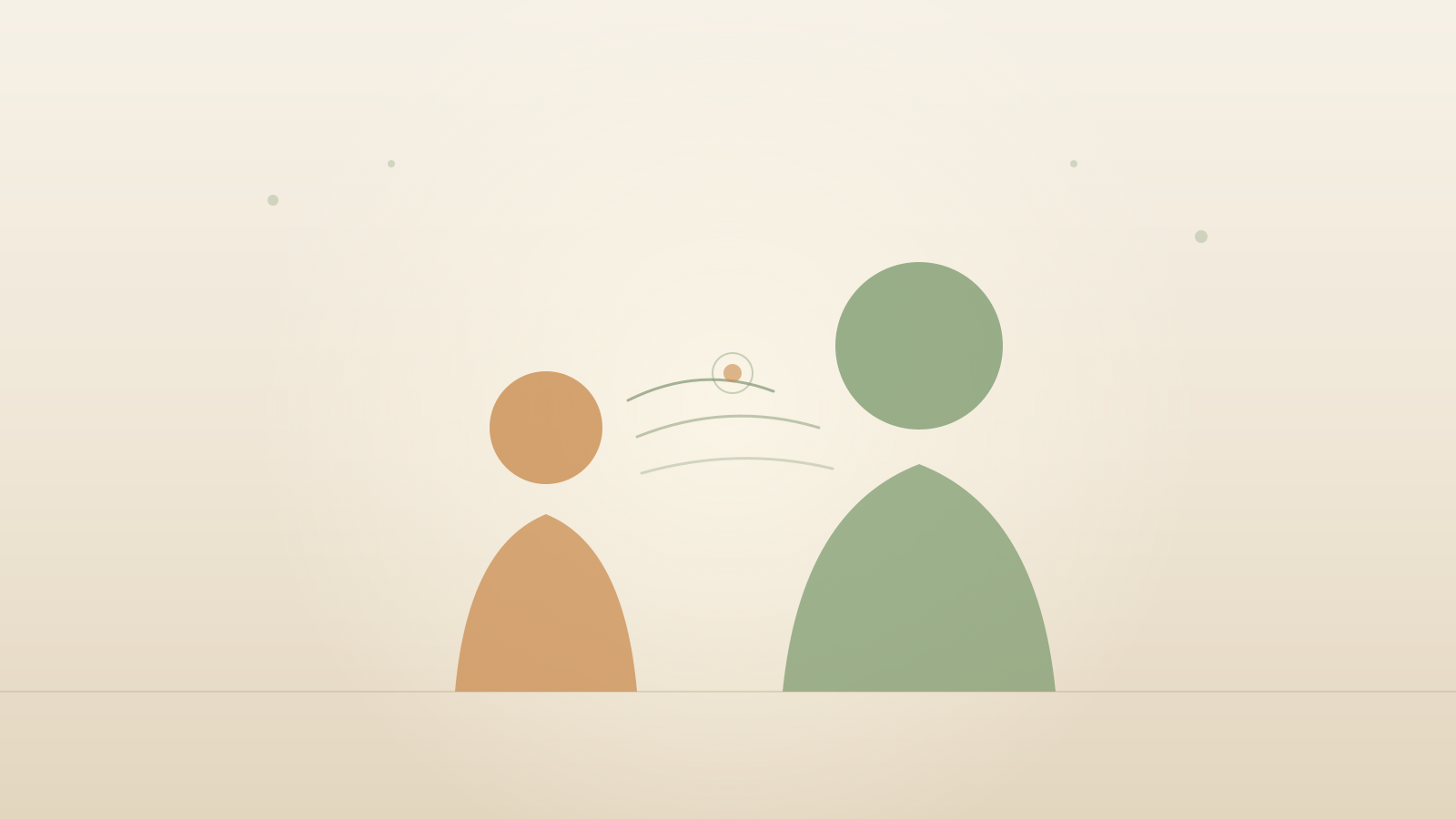
The Moment Someone Says "You Know What..."
It is early evening. Your hands are busy in the kitchen, and your child comes up and says, "You know what..." With your back still turned, you answer, "Mm-hm, what is it?" One eye on the pot, one eye on your phone, you give only half an ear. Isn't this a scene that plays out, almost daily, in countless homes?
A child's "you know what" is usually nothing major to an adult—a bug they saw today, what was for lunch, some small exchange with a friend. That's exactly why we let ourselves half-listen. Yet to that child, it is the most important thing they want to share, right now. What they're after may not be the content of the story at all, but the felt sense of having been heard.
Zen has a deep teaching about how to live this single moment in front of us. And in the ordinary act of listening lies a perfect place to practice it.
Nikon: This One Moment Is Everything
Dogen, founder of the Soto school of Zen, treasured the word nikon—"this very moment." Nikon is neither the past that has gone nor the future not yet arrived; it is precisely "now, this one instant." In his Shobogenzo, Dogen taught that past, present, and future are not lined up separately, but that each moment is a complete "whole" in itself.
Lay this teaching over a child's "you know what." The instant the child speaks to you—that is a scene in their life that will never come again. "I'll listen carefully later," "I'll face them when my hands are free"—and while you think this, the feeling that wanted to say "you know what" deflates and disappears. To live nikon is to receive that one moment whole, now, without postponing it to "later."
Half-Listening Is the Mind Being Absent
Zen cautions against the state in which the mind has wandered away from the present place. Your hands work the pot, your ears are half-turned to the child, and your head circles through today's tasks and tomorrow's plans—this is precisely the mind being absent from "here and now."
Even if you keep nodding "uh-huh," when your mind is elsewhere, the other person feels it. Children are sensitive. Even if they get a verbal reply, when your eyes don't meet theirs and your body isn't turned toward them, they sense, "I'm not really being heard." Conversely, even for a brief moment, when an adult stops what they're doing, meets their eyes, and listens whole-heartedly, that alone fills the child with the reassurance, "I matter."
The quality of listening is not measured by length of time. Even in an instant, is the heart fully there? That single point is what Zen asks.
What Thirty Seconds of Stopping Changed
I myself often used to let my child's stories drift past me, only half-present, on busy evenings. One day, my child started to say "you know what," then suddenly fell silent. Facing my turned back, they seemed to lose the will to go on.
That small silence struck me in the chest. The next time "you know what" came, I made myself stop, crouched down to their eye level, and gave the story my whole attention for just thirty seconds. The content was, again, a trifling tale about finding a bug. But the satisfied look on my child's face when they finished—seeing that expression, I understood. What my child wanted was not fine advice or a long stretch of time, but a single gaze that said, "Right now, I am listening to you." Stopping took only thirty seconds. And yet those thirty seconds truly changed something.
Listening With the Whole Body: A Zen Practice
To listen with the heart of Zen requires no special technique. You only change where you place your mind. Here are three practices you can try in daily life.
First, "stop your hands." When someone speaks to you, pause what you're doing as much as you can. Set down the knife; turn the phone face-down. That small gesture alone is the clearest signal of all: "I am turning my heart toward you."
Second, "turn your whole body." Turn not just your face but your shoulders and chest toward the other person. With a child, crouch to meet their eye level. The direction of the body mirrors the direction of the heart.
Third, "don't prepare your next words." We tend to work out "how should I respond" while still listening. But that is the mind leaving the other's words and turning inward. Trust the reply to arise naturally once you've finished listening. While listening, devote yourself wholly to listening.
The Difference Between Hearing and Listening
In English too there is a difference between "hearing" and "listening." Hearing is sound arriving naturally at the ear. Listening is actively inclining the heart, straining the ear with attention. What Zen values is the latter—listening.
It is easy to merely "hear" a child's "you know what" as sound. But to "listen" to it together with the child's feelings, your heart must be here, now. Without evaluating the content or rushing to a conclusion, you simply receive, whole, what the child is feeling and wanting to convey in this moment. This is not limited to children. A partner's grumbling, a parent's oft-repeated old story, a colleague's rambling concern—in every such moment, we can change "hearing" into "listening."
The Memory of Being Heard Sustains a Person
Looking back as adults, we have forgotten most of what happened in childhood. Yet the feeling of "back then, I was really listened to" strangely lingers deep in the heart. Even when we don't remember what we said, the felt texture of having been heard becomes a foundation that supports a person for a long time.
To live nikon is not some grand resolution. It is simply to receive the moment before you without letting it wash away into "later." A child's "you know what" may be the nearest opportunity to practice exactly that. For the instant you are spoken to is itself an irreplaceable "now" that will never return.
Today, Stop Your Hands at the First "You Know What"
Not tomorrow, not next week—today. The next time someone says "you know what" or "got a sec?", stop your hands just a little, turn your body, and incline your whole heart to listen. It need not be long. Thirty seconds is enough.
If, in that brief time, your heart is wholly there, the other person will surely receive it. And the experience of being listened to, whole, will come full circle and return to you as the warmth of someone listening to you in turn. Turning your heart toward the person in front of you—this is the gentlest practice Zen hands us within everyday life.
About the Author
Zen Insightful Editorial TeamWe share Zen teachings in a way that is easy to understand and applicable to modern life.
View author profile →Related Articles
How Expecting Too Much of Others Quietly Poisons Your Relationships, and the Zen Wisdom of Letting It Go
Do You Feel Safe Only When You're Busy? The Zen Art of Releasing the Belief That Busyness Equals Worth
The Finger Pointing at the Moon: How Zen Frees You From Obsessing Over Methods and Returns You to What Matters
Taking a Different Way Home Changes the World: Zen's Beginner's Mind in Daily Life