For Those Who Tire the More They Chase Perfection: The Zen Wisdom of Working at Seven-Tenths
The harder you push for perfection, the more both your results and your peace seem to wear away. Drawing on the Zen Middle Way and the practice of samu, here is the wisdom of working at seven-tenths and three practices to try today.
You Are Giving It Your All, and Still Spinning Your Wheels
Those who have always told themselves "never cut corners, always give one hundred percent" often hit a strange wall. Despite working this hard, results somehow stop improving. If anything, mistakes multiply, the mind wears thin, and rest no longer restores. You wring out ten units of effort every time, yet ten units of results never come back—that is the feeling.
Zen has a foundational teaching called the Middle Way. What the Buddha discovered after years of extreme austerity was neither severe self-denial nor indulgence in pleasure, but the path that runs down the middle. This applies to how we work, too. Always charging ahead at full throttle is, in fact, an "extreme" that strays from the Middle Way. What Zen points to is a paradox: by holding your effort to seven-tenths, you can actually work longer, deeper, and more steadily.
An Overstrained Bow Will Eventually Snap
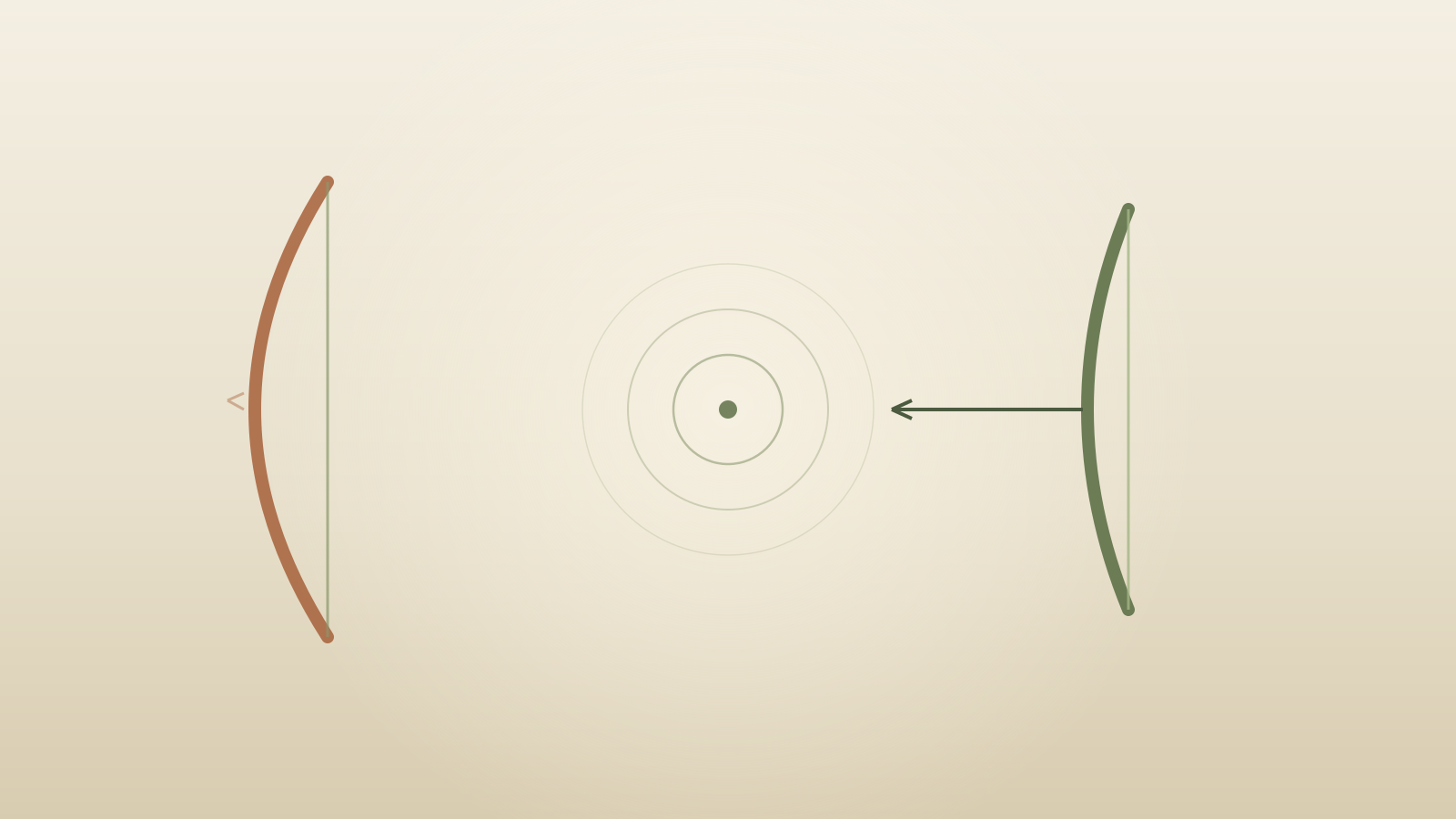
From ancient times there is a teaching that likens the state of body and mind to a bow. A bow drawn to its absolute limit does generate great force, but hold it there and the string and the bow itself are damaged, until at last it breaks. A bow left too slack, on the other hand, cannot send the arrow at all. It is precisely the right tension that carries the arrow farthest.
The "full effort" of work is the same. If you try to give one hundred percent every time, on every task, all day long, the bow stays drawn and can never return. Concentration dries up, judgment dulls, and you grow irritable over trifles. "Seven-tenths" is not the same as slacking off. It is the deliberate keeping of a margin to return to, so the bow does not break—a wisdom for going on shooting for a long time.
Dogen on Samu: Work Itself Is Practice
In Zen, work is never a half-hearted aside. Dogen, founder of the Soto school, ranked the work of the tenzo—the monk in charge of meals—very highly. In his Instructions for the Cook, he taught that washing the rice and making the soup, each single act, is practice itself. Cleaning, splitting firewood, tending the field—in Zen these are called samu, and they are held to carry the same weight as seated meditation.
What matters here is the state of mind we bring to the work. Dogen taught not the rushing of results in a frantic scramble, but pouring careful attention into the one thing your hands are doing right now. If you are scrubbing a pot, become wholly the scrubbing of the pot. Do not do it half-heartedly while fretting over the next task. Ironically, when we are tensed up to "give it our all and produce results," our minds are usually not on the task before us but have flown ahead to the evaluation or the deadline. Sinking deeply into the one thing before you at seven-tenths is far closer to the spirit of samu.
The Night Before a Deadline, I Let Go and It Came Loose
Once I was stuck with a document I simply could not finish, hunched over my desk late into the night. The more I fiddled with details trying to make it perfect, the more tangled the writing became, my head hot and spinning in place. I remember my shoulders gone hard as stone with anxiety.
Finally I gave up, set down my pen, and brewed a cup of tea in the kitchen. Watching the steam rise, I simply sipped the warm tea—just a few minutes. When I sat back down, the flow of a single sentence that I could not see before suddenly came clear. The part that needed fixing was only a few lines, and all that suffering felt like a lie. What I could not see while gripping at one hundred percent appeared on its own the moment I loosened to seven-tenths and made a little room. That night I learned that the way out lies in the opposite direction from "try harder."
Three Ways to Practice Working at Seven-Tenths
Seven-tenths cannot be sustained by attitude alone. Here are three concrete methods.
First, "produce a seven-tenths shape before a finished one." Aiming for a perfect finished product from the start makes the first step heavy and your hands tend to freeze. Instead, quickly throw together a rough seventy-percent form. Once the whole is visible, however crude, the remaining thirty percent fills in with surprising ease. "Rough is fine, just get to the end"—this echoes the never-stop-your-hands spirit of samu.
Second, "loosen the bow at every break." After about fifty minutes of focus, deliberately let go of the tension for a few minutes. Stand up and look out the window, take three slow breaths, brew some tea. Keep returning the constantly drawn bow to rest. These small margins are what keep your concentration alive into the afternoon.
Third, "have the courage to let go at seven-tenths." There is always a point past which no one will notice further polishing. To pour ten or twelve units of effort beyond that point is, more often than not, no longer work but self-satisfaction or the patching of anxiety. To judge "this is enough" and let go is a skill in itself.
"Just Enough" Is Not Laziness
Hearing "work at seven-tenths," some may feel the guilt of cutting corners. But this is utterly different from laziness. It is, rather, a strategic allocation that keeps enough strength in reserve for the work that matters most.
If you burn through one hundred percent on the day's first task, by the time the truly important decision comes in the afternoon there is nothing left to squeeze out. The person who moves at seven-tenths always carries thirty percent in reserve for when it counts. The desperate burst of superhuman strength comes only once; seven-tenths can be sustained every day. Over the long run, the one who keeps working at just enough accomplishes far more.
Zen honors the Middle Way not because it is a compromise, but because it is precisely the path on which our strength is most fully released.
Today, Do Just One Thing at Seven-Tenths
You need not overhaul how you work all at once. Today, pick just one of your tasks and consciously do it at seven-tenths. Don't demand perfection; once the seventy-percent shape is there, let go for a moment. And with the tension gone from your shoulders, turn your heart a little more carefully toward the task itself.
Most likely, the result will not fall as far as you fear. On the contrary, a margin will open in your mind, and you will notice your head is still clear come afternoon. To loosen the overstrained bow is not weakness, but the quiet strength of one who means to go on shooting for a long time.
About the Author
Zen Insightful Editorial TeamWe share Zen teachings in a way that is easy to understand and applicable to modern life.
View author profile →Related Articles
Autumn Nights, Listening to the Insects: How Zen Uses Nature's Sounds to Settle the Heart
Experiencing the Moment Without Photographing It: How Zen Frees You From Clinging to the Record
Listening to a Child's 'You Know What...' All the Way Through: How Zen Teaches Us to Be Fully Present With the Person in Front of Us
How Expecting Too Much of Others Quietly Poisons Your Relationships, and the Zen Wisdom of Letting It Go