Paper and Pen Are Enough: How Zen's Simplicity Frees You from Digital Excess
Note apps, task managers, cloud notebooks—discover how returning to paper and pen embodies Zen simplicity and declutters your digital life.
The Infinity Trap: How Digital Tools Clutter the Mind
Why do supposedly convenient digital tools scatter our minds? The root cause is that digital is designed on the premise of infinity. Note apps have no storage limits, and cloud storage can expand endlessly with a monthly fee. Articles saved 'just in case,' screenshots, PDFs, recipes, idea memos—they pile up until organizing them becomes a massive task in itself.
Research by Professor Gloria Mark at UC Irvine reports that the average time modern people can focus on a single digital screen has shrunk to just 47 seconds. Notifications, tabs, app switching—an infinitely expanding information space fragments our attention.
Zen teaches shoyoku-chisoku—few desires, knowing sufficiency—as the foundation of daily life. A paper notebook has physical limits. When one is full, you open a new one and let go of the old. This very finitude naturally encourages discernment. Digital infinity looks like freedom but multiplies the burden of choice without end.
The Science: Why Paper Strengthens Memory and Clarifies Thought
The act of writing by hand involves the body in a way typing cannot. Gripping the pen, feeling ink seep into paper, slowly forming each character—this process is itself a meditative experience akin to Zen calligraphy.
In 2014, researchers at Princeton and UCLA published the famous paper 'The Pen Is Mightier Than the Keyboard,' showing that students who took lecture notes by hand scored significantly higher on conceptual understanding tests than those using laptops. Typing approaches stenography and records verbatim, whereas handwriting is slower, forcing the brain to summarize and restructure information—deepening both understanding and retention.
Professor Kuniyoshi Sakai at the University of Tokyo also found that participants who recorded schedules by hand outperformed smartphone users on memory recall tasks, with more active engagement in the hippocampus and language areas. The texture of paper, the weight of the pen, the scent of ink—this multisensory stimulation strengthens memory.
One Notebook Principle: Learning from Zen Monks
Visit a Zen temple and you'll be struck by how few tools monks carry. A sutra book, a robe, an oryoki (eating bowl), one ledger, and one brush. That's enough for a day. Owning little is not poverty but the abundance of using each thing fully.
Adopt this 'one notebook principle.' Keep memos, diary, tasks, reading notes, and shopping lists all in one notebook. Don't divide pages by category; write chronologically. Not separating 'work' from 'personal' matters, because life itself is not compartmentalized.
With one notebook, everything related to 'here and now' is captured in a single place. Zero time is spent hunting across apps. By the time the notebook fills, months of your thoughts and actions are distilled in one volume—and simply reviewing it becomes a practice of reflection.
A young Soto Zen monk I know keeps daily records of temple labor and zazen in a single bound notebook, written in ink. 'When I divide writing by category, I feel like my life itself gets chopped up,' he says. Work and family, hobbies and learning, joy and sorrow—the modern habit of splitting what was originally continuous into separate apps may be fragmenting our very sense of living.
Write Only Three: The Zen Practice of Morning Task Selection
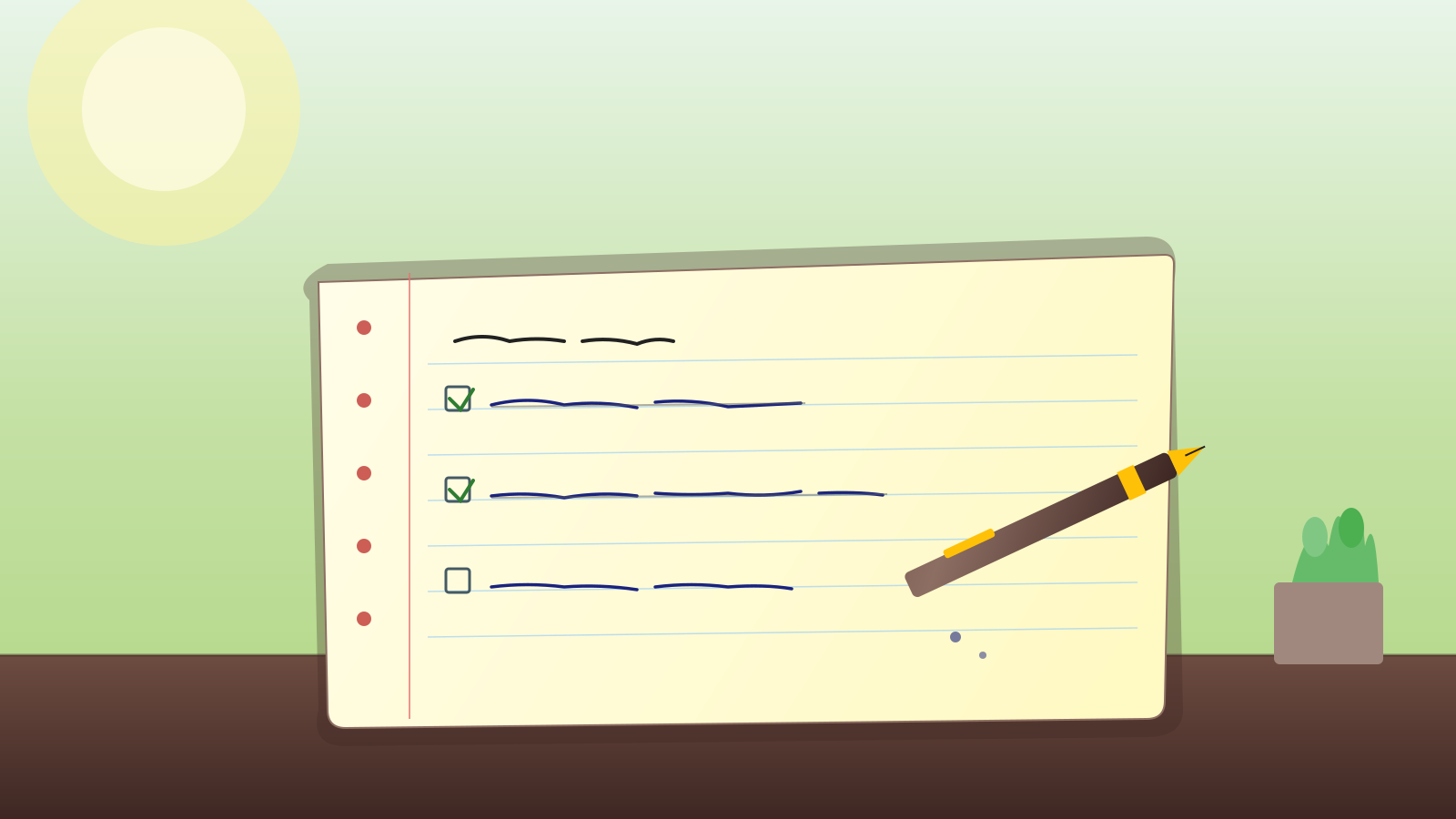
Starting tomorrow, handwrite your daily to-do list on paper. An A6 notepad and one pen are enough. The steps are simple.
First, upon waking, sit for three minutes and breathe deeply. Second, write down only three things to accomplish that day. Limiting to three is essential—just as Zen monks minimize possessions, minimize your tasks. Third, add an estimated time for each. Fourth, draw a thick line through each completed item. Fifth, at day's end, review and transcribe only what carries over onto a new page.
Limiting to three aligns with findings in cognitive psychology on working memory capacity. Since George Miller's classic paper on 'the magical number seven, plus or minus two,' researchers such as Nelson Cowan have reported that humans can consciously hold only three or four items at a time. Barbara Oakley of Oakland University (Michigan) likewise emphasizes in her book 'Learning How to Learn' the importance of narrowing attention to a small number of items. A list of ten tasks actually produces a paralysis where nothing gets done. Three items let what truly matters rise naturally.
Writing and Discarding: Paper as the Art of Letting Go
Paper's greatest strength is that it can be thrown away easily. Digital data, even deleted, leaves the lingering sense that something remains in the cloud. Paper, torn and dropped in the trash, is simply done. This sense of ending embodies the Zen practice of hoge-jaku—let go.
Here is a concrete method. When anger or anxiety fills your head, scribble it down on paper without thinking. The handwriting can be messy. When finished, tear the paper and throw it away. Writing externalizes the emotion; tearing psychologically closes the chapter. Cognitive behavioral therapy confirms that verbalizing emotions reduces anxiety, and the expressive writing research tradition begun by James Pennebaker has reported improvements in stress indicators and anxiety even after brief writing sessions.
At the end of each week, review the pages you wrote and tear out those that are completed or no longer relevant. This is not mere tidying but a ritual for consciously closing the week. Like cleaning a room, it creates open space inside the mind.
What You Need to Live Richly with Only Paper and Pen
Returning to paper and pen doesn't mean rejecting digital entirely. Use digital tools where sharing is required—calendars, messaging. What matters is this: the place where you record your inner life—thoughts, feelings, insights, plans—returns to paper.
You need only three tools to start. First, one notebook you like (palm-sized is easiest to sustain). Second, one pen with good flow (no skipping ink). Third, a fixed spot for the notebook (upper right of your desk, within arm's reach). No need for expensive items. Zen honors not luxurious tools but careful use.
After three months, you'll notice: what truly matters always fits within three items. A quiet time free from notifications returns to your day. And paper and pen alone are more than enough to run your life and fill your heart.
Dogen Zenji wrote in the Shobogenzo, 'To study the Buddha way is to study the self.' To know yourself, you need to pause the constantly flowing stream of thought and look at it from outside. A smartphone screen is always filled with other people's information, but what lines up on paper is your handwriting, your words, your choices alone. In that open space, you can quietly meet yourself again. Shoyoku-chisoku—within fewness, true abundance dwells.
About the Author
Zen Insightful Editorial TeamWe share Zen teachings in a way that is easy to understand and applicable to modern life.
View author profile →Related Articles
Do You Actually Taste Your Bread? How Zen Awareness Transforms the Simplest Meal
Has Anyone Seen the Moment Water Boils? A Zen Koan on the Illusion of Boundaries in Change
Watching Your Own Shadow: How Zen Awareness Teaches You to Dialogue with Your Other Self
Standing Before a Locked Door: The Zen Koan That Teaches the Wisdom of Waiting