Wiping Houseplant Leaves, One by One: A Quiet Samu That Slowly Settles the Heart
We remember to water our houseplants, yet rarely think to wipe their leaves. Thirty unhurried minutes spent dusting each leaf with a soft cloth—unrewarded, easily skipped—turns out to be a quiet samu close to what Zen monks practice in the monastery. This piece traces what happens between the hand and the leaf.
We Remember to Water Them, but Never to Wipe
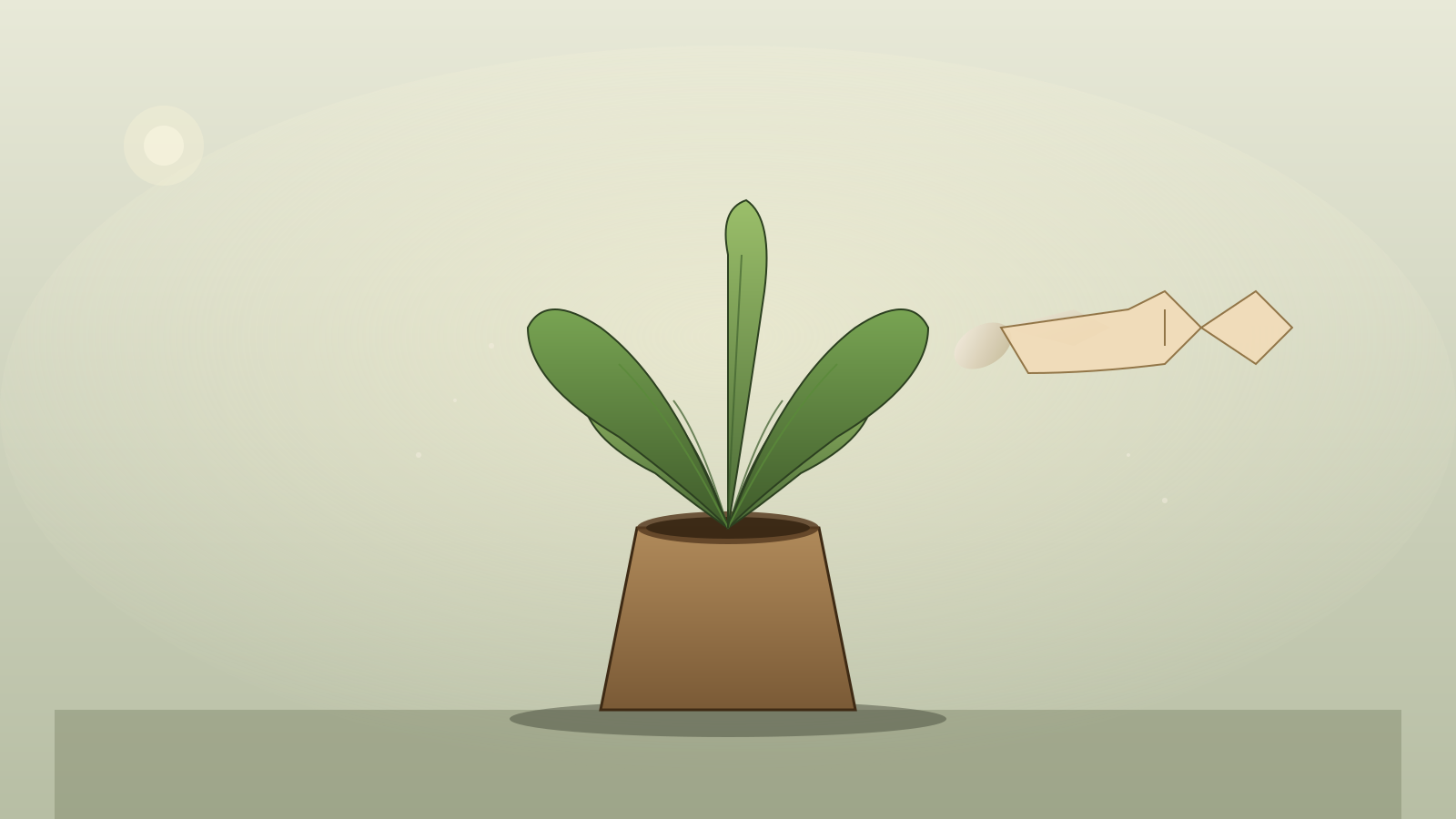
In a quiet corner of the room a houseplant spreads its leaves. We remember the watering, but we almost always forget the wiping. Without noticing, a thin gray layer of dust settles on the leaves; the veins that once caught the light look dulled. The plant does not complain, so the small grime goes unseen for a long time. Yet for a houseplant, dust is more than aesthetic. The stomata on a leaf are passages for photosynthesis and transpiration, and a film of dust slowly chokes the plant's natural functions. The same is curiously true for us. Small daily fatigues and minor frustrations form a thin layer over the heart, and our breathing grows shallower than we realize. Wiping a leaf is at once an act that returns breath to the plant and a quiet act that returns breath to ourselves.
'Wiping' as Practice in the Zen Monastery
In the morning at a Zen monastery, monks wipe the wooden corridors with damp cloths. It is not only cleaning. Repeating the same motion on the same floor day after day has a settling effect on the heart. In monasteries such as Eiheiji, wiping the corridor floor has long been considered one of the pillars of practice. The act of wiping shares three traits. First, you touch the object directly through hand and cloth. Second, the area you face has a visible boundary. Third, when you finish, what you faced is a little cleaner than before. Wiping a houseplant's leaves satisfies all three: direct contact, visible scope, visible change. That is why the structure of corridor wiping can quietly be re-created inside an apartment. Thirty minutes spent on each leaf is a small, modern completion of samu—the working practice of Zen—inside our own homes.
The Practice: Thirty Minutes, Leaf by Leaf
You need three things. A soft cloth (an old T-shirt cut into squares is fine), a small bowl of lukewarm water, and a timer. First, dip the cloth and wring it firmly. Damp but not dripping. Cold water is too sharp for both leaf and hand; lukewarm is kinder. Second, sit or crouch in front of the plant. Standing tempts you to hurry. Lowering your hips itself becomes a signal: "This will be slow." Third, support a leaf gently from below with your palm. Don't lift it forcibly—rather, hold it as if between cloth and palm. Fourth, wipe the upper surface once, from base to tip, in one direction only. No back-and-forth. A single pass along the veins protects the leaf and gives the motion a clear ending. Fifth, wipe the underside the same way, once. The underside is where small insects and eggs hide, and wiping there does the plant the most good. For very small leaves, simply pinch the cloth around a fingertip and run it across once. Each leaf takes ten to twenty seconds; thirty leaves take just under ten minutes.
You Can Only Advance One Leaf at a Time
The most important quality of this work is that it can only proceed one leaf at a time. You cannot wipe ten in a single sweep. Each leaf has its own shape, its own angle, its own amount of dust, and the hand must adjust to each one. This is the natural form of what Zen calls ichiji-ichiji—one moment, one matter. You do not need to enforce single-tasking on yourself; the structure of the plant itself escorts you there. One Sunday evening I was unable to stop replaying the next morning's meeting in my head. I sat at the desk and could not focus. Almost without thinking, I stood up, crouched in front of the plant, and began to wipe. For the first three or four leaves, the meeting voice was still going. But somewhere around the tenth leaf, the inner voice quietly lowered in volume, and only the soft give of the leaf and the slightly cool damp of the cloth remained. When I finished, the issues for tomorrow had quietly sorted themselves into 'solvable now' and 'better left until Monday.'
What the Renewed Sheen of a Leaf Teaches
A wiped plant visibly changes. The green deepens a tone, the veins emerge, and light catches the surface gently. This is not merely cosmetic. With the dust gone, the leaf has resumed its full function. A while later you notice that something similar has happened inside you. The thin film of fatigue that lay over your head thirty minutes ago has, somehow, flowed away with the dust. Zen teaches that outer work and inner state are linked at a deep level. Tidy the outside and the inside settles; settle the inside and the outside finds order. Wiping leaves lets you taste that link in one of its gentlest forms. Vacuuming the floor or clearing the desk do similar work, but wiping leaves carries a particular softness, because the object is alive. Time spent touching something living has a different quality from time spent on the inanimate.
Make a 'Leaf Day' Once a Month
You do not need to wipe leaves daily. Forced daily wiping turns the practice into a chore and strips it of its samu nature. Once a month, or every two weeks, mark a 'Leaf Day.' Perhaps the first Sunday evening of the month, or a rainy afternoon when you cannot go out. Set a thirty-minute timer, turn off the TV and music, and crouch in front of the plant. When you are done, brew a cup of tea and drink it slowly, gazing at the plant that has just regained its sheen. From that simple act, once a month, you can rediscover an obvious fact: you live in this home together with this plant. The plant asks for nothing, yet by watering it we shape our days, and by wiping its leaves we quietly shape our minds. Next weekend, if you feel a little scattered, before sitting at the desk, sit instead before the plant in the corner of your room. A soft cloth, lukewarm water, thirty minutes. Within that, the wiping practice that Zen monks have honored for centuries will breathe quietly inside your own hand.
About the Author
Zen Insightful Editorial TeamWe share Zen teachings in a way that is easy to understand and applicable to modern life.
View author profile →Related Articles
Three Seconds at the Doorstep: A Small Zen Practice for the Edge Between Outside and Inside
Three Breaths Before an Online Meeting: A Zen Way to Settle Yourself Before Hitting 'Join'
Rearranging What's in the Fridge: How Picking Up One Item at a Time Brings Deep Focus
On the Nights No Reply Comes: How Zen's Teaching of Emptiness Eases the Silence After Read