The Zen of Turning Off Lights One by One: A Subtraction Ritual That Quietly Closes the Day
Turn the simple act of switching off lights before bed into a Zen ritual. Learn how subtracting light one bulb at a time consciously closes the day and leads to deeper sleep.
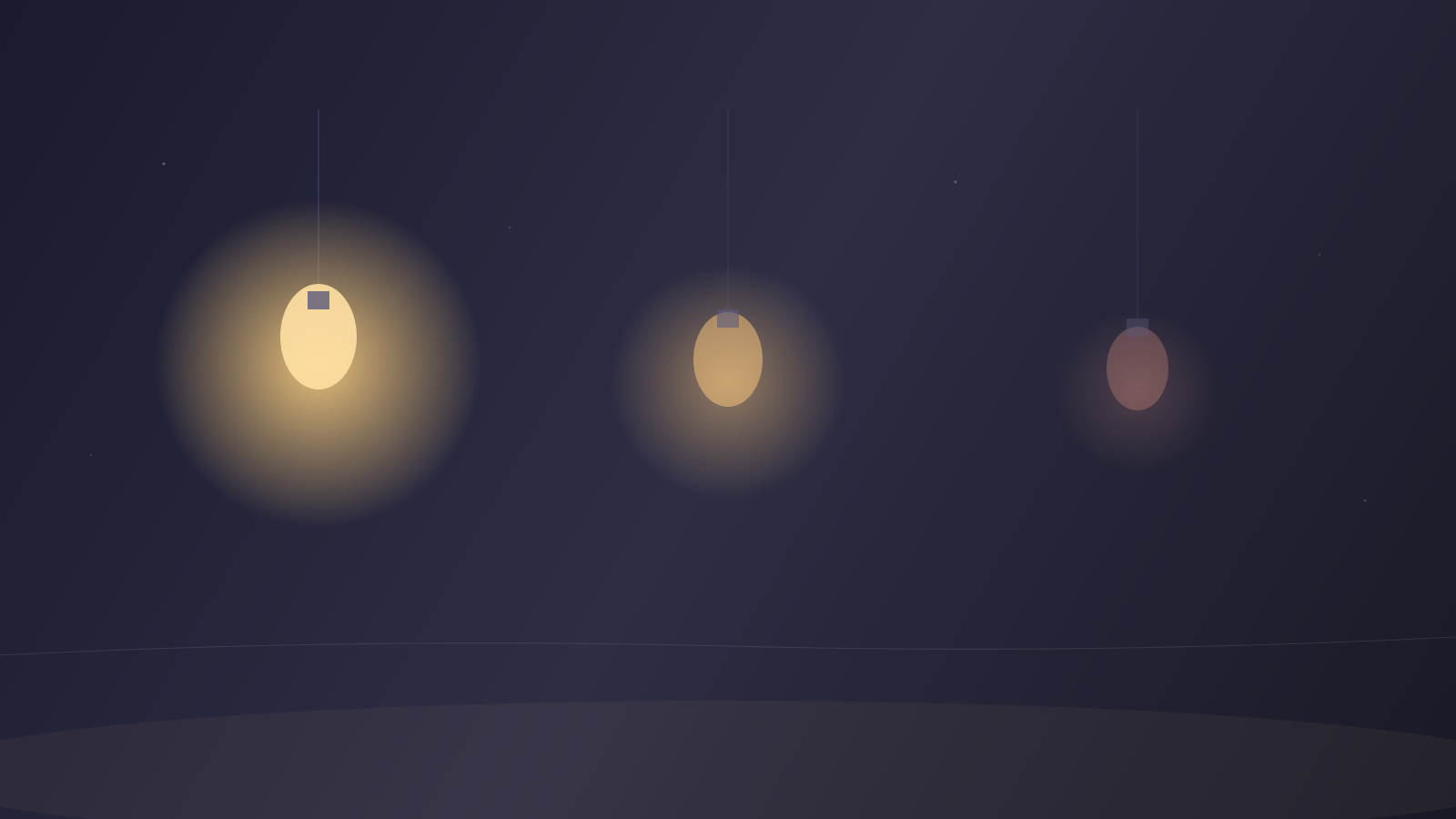
'Killing All the Lights' Does Not Close the Day
Many of us end the day by hitting one remote or wall switch that plunges the room into darkness. In that instant the bright world simply switches off, but everything that has been running in our mind today keeps going. The lights are out, but the lights inside the head are still on, which is why we so often reach for the phone once we are already in bed. We turned down the brightness, but we never gave ourselves time to turn down the afterglow of the day.
A Zen monastery's night is the exact opposite. Lights go down one at a time, with long pauses between each one, until the final small flame is finally extinguished. A day that began at 3:30 in the morning is gently closed by gradually dimming candle-like lights. 'Subtracting light' is not just about saving electricity; it is a proper ritual that escorts the mind to sleep. Even at home, simply turning off our bulbs one by one transforms the quality of our nights.
Dogen's 'Walking, Standing, Sitting, Lying Down' Applied to Evenings
In Shobogenzo, Master Dogen taught that every daily action — walking, standing, sitting, lying down — is itself practice. Turning off a light is no exception. 'My right hand touches the wall switch, my fingertip feels the firmness of the toggle, I press it down, click, and the room dims.' If we can taste this little sequence as a single integrated motion, it is already samu (work practice) and zazen.
Zen temples display the words kyakka shoko, 'look beneath your feet,' in their entrances and corridors. See your own footing, see where you are right now. Going around the house turning lights off is, quite literally, walking through the house while looking beneath your feet. Once light has been reduced, you suddenly notice the crack on the floor, the small stain on the wallpaper, the corner of the hallway you have passed unseeing for years. The world that only appears when light is reduced reminds you, in the body, 'I live in this house.' That, too, is part of the richness subtraction gives back.
A Three-Stage Subtraction of Light
The practice is simple and starts about thirty minutes before bedtime. Here is the sequence.
Stage one, cut the overall light in half. Thirty minutes before bed, turn off the ceiling light or the main fixture. Leave only an indirect lamp, a desk light, or one small table lamp. The room is darker now, but you can still see your hands and face. If the TV is on, switch it off; place the phone face down somewhere out of sight.
Stage two, walk the house and turn the lights off. After washing up, do not march straight to the bedroom. Walk slowly through the house, leaving only the entrance light, hallway light, and bathroom night light, and switch off everything else by hand. Do not use a remote or smart speaker for a mass off. Walk on your own feet; touch each switch with your own finger. That matters. The kitchen range hood, the desk lamp, the indirect light, finally the small living-room lamp. With each one, you can quietly think, 'What happened here today is over now,' and place and day begin to part.
Stage three, the last light. In the bedroom, leave only the small bedside lamp. Slip into bed and take three slow breaths. With each breath, recall one scene from today and silently add the words 'thank you.' When the three breaths are done, click off the last lamp. That moment is the day's true curtain.
Why 'All Off' and 'One at a Time' Are So Different
Why bother going through all of this? Because the human mind is bad at slamming on the brakes. A brain that has been working all day does not need an on/off switch; it needs a downhill slope. The strong white LED light from a ceiling fixture sends short-wavelength blue light around 460 nanometers into the melanopsin cells of the eye, telling the brain 'it is still daytime.' Turning that off thirty minutes before bed opens the gate for melatonin to begin.
But the real point is not the lumens; it is the continuity of action. Switching off one light, then another, is the way we send our own body the message 'we are going to sleep now.' The texture of the toggle, the feel of the darkened hallway under your feet, the final click and the room sinking into shadow — only when these physical cues line up does the heart finally accept that the day is over.
Not long ago I used to read work email on my phone even after I was already in bed. One evening I tried, just as an experiment, going through the house and switching off the lights one by one before sleeping. The first few nights I thought 'what a hassle.' But after about three days, I remember the moment I clicked off the small kitchen light: I felt my shoulders drop. Nothing special had happened. Walking slowly through a dimming home, it simply felt as though the person who had been working today was telling himself, 'You may rest now.' Since then, by the time I reach the bedroom my body is naturally ready for sleep.
What You Begin to See When Light Is Subtracted
Reduce light and of course many things become invisible. Strangely, other things start to appear. The sound of the house, the low hum of the air conditioner, the vibration of the refrigerator, the breath of the wind outside. Faint presences that were drowned out by visual information now come forward sharply in the dark.
A famous Zen phrase, kakunen mu-sho — 'vast openness, nothing holy' — was Bodhidharma's reply to Emperor Wu of Liang. No grand ornaments, no special enlightenment. Only what is in front of you. When you stand in your darkened home and listen, you can sometimes touch exactly that feeling: in the empty darkness, only the sound of your own breath and the house just as it is remain.
The same happens with the self. In a brightly lit room, every object in sight — furniture, books, phone, the contents of the fridge — hooks another 'something to do' or 'something to worry about' onto your thoughts. As each light goes off, the small mountain of unfinished tasks inside your head also gets a little shorter. Subtracting light from the house turns out to be subtracting unfinished business from the heart.
Small Tips and Cautions to Keep This Going
A few practical tips. First, fix the order. Living room → kitchen → hallway → bathroom → bedroom: lock in a route, and your body will move without thinking, which speeds up the habit. Second, make the final light a warm color temperature (around 2700K, an incandescent tone). A candle-orange light disturbs melatonin far less than white light. Third, if you live with family, only turn off the lights along your own path. Quietly switching off lights other people are using is just interference. Subtract only your own route. That is part of the humility of practice.
This ritual is less about 'ending' the day and more about 'closing' it. The house, the lights, the body — all of them worked for you again today. You bow inwardly to them before sleep. Inside the most ordinary act imaginable, switching off a bulb, sleeps a quiet power to put life back in order. Tonight, instead of killing everything at once with a remote, try turning them off one at a time with your own hand. From that alone, the quality of tomorrow's waking will begin to change.
About the Author
Zen Insightful Editorial TeamWe share Zen teachings in a way that is easy to understand and applicable to modern life.
View author profile →Related Articles
The Beauty of an Old Wooden Spatula: Wabi-Sabi in One Tool Used for Years
Awareness of Both Elbows: How an Overlooked Joint Quietly Brings the Mind Back to Earth
Bringing in the Laundry at Dusk: A Quiet Samu That Gently Closes the Day
Wiping Houseplant Leaves, One by One: A Quiet Samu That Slowly Settles the Heart