Awareness of Both Elbows: How an Overlooked Joint Quietly Brings the Mind Back to Earth
Most of us can describe our breath or posture, but very few can answer where our elbows currently are, at what angle, at what temperature. Spending a few minutes turning awareness toward this overlooked joint widens attention from a head-heavy state out to the body's edges, and gently brings the mind back to the ground.
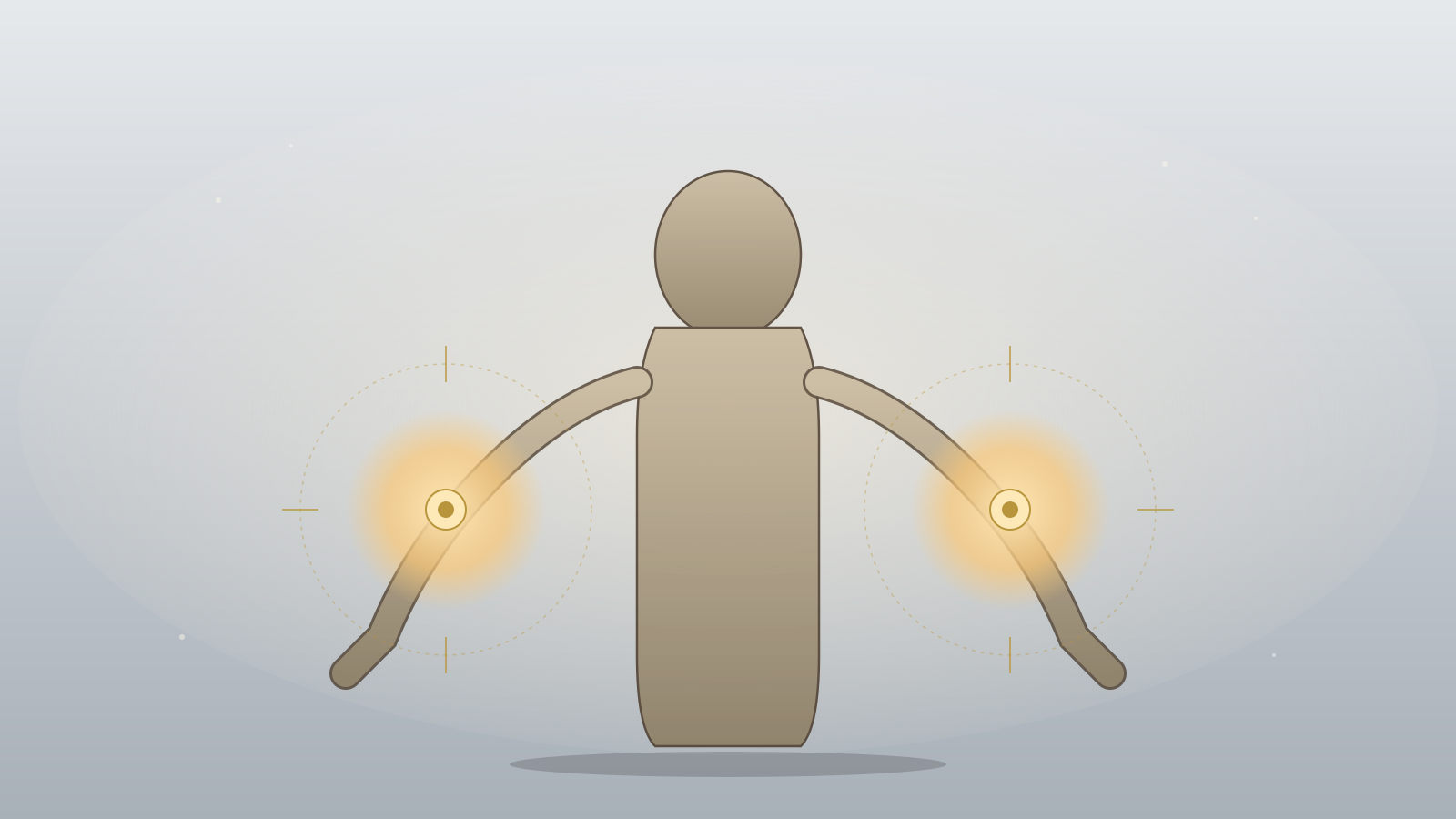
'Where Are Your Elbows Right Now?'
In zazen or mindfulness, we instinctively bring attention to breath, posture, leg position, hand placement. But if you are asked, suddenly, 'Where are both your elbows right now?' most people pause. Beside the ribs? A little open? Resting on the desk? Hanging by the body? The elbow is rarely talked about. It does not complain like the lower back or shoulders, and it doesn't ache like the knees. So for most of the day, it falls completely out of awareness. Yet the elbow is the hinge that links arm and torso, involved in nearly every motion: writing, carrying, holding, cooking, lifting a child. It moves hundreds of times a day, and we forget it almost entirely. The moment we direct awareness there, attention that had pooled in the head spreads outward to the edges of the body.
'Sensing the Body to Its Corners' in the Zen Tradition
Dogen Zenji, in *Fukan Zazengi*, describes in fine detail how to align the body for zazen: hips, back, the position of the head, the hand mudra (hokkai-jo-in), even the tongue's resting place. Tuning the body down to its details is treated as the precondition for tuning the mind. This is the Zen stance: rather than working directly on the mind, first align the body. Later masters likewise valued 'letting awareness reach every corner of the body.' Traditional Buddhist contemplation methods such as kaya-anupassana (mindfulness of the body), close to what we now call body scanning, walk attention from the crown of the head to the tips of the toes, confirming places usually missed. Among those traditionally observed sites, the elbow is one of the most easily forgotten. That is exactly why turning attention there brings a fresh edge to familiar meditation.
The Practice: A Three-Minute Elbow Scan
No special posture is required. Sit in a chair. Lengthen the spine gently, plant both feet on the floor, rest hands on thighs or knees. Set a timer for three minutes. First, with eyes closed, mentally 'point at' where each elbow is. No need to use a finger; sensing 'here' in the mind is enough. Many people, at first, find the location of one or both elbows surprisingly vague. That's fine. Noticing the vagueness is already observation. Second, register the angle of each elbow joint. Near a right angle? More open? Almost extended? Don't change the angle. Just read what it currently is. Third, sense the temperature around the elbow's skin. The inner and outer sides may differ slightly. An elbow covered by a sleeve feels different from one exposed to the air. Fourth, explore the 'inner feel' of the joint itself. Is there a small tension, a faint pulse, or nothing? If nothing, accept that as 'feeling no feeling.' Finally, hold both elbows in awareness simultaneously, as if they were two small points of light, sensed at once.
The Strange Moment of 'Oh, I Have Elbows'
What is striking is that the moment you notice your elbows, the outline of your whole body sharpens. We habitually pour attention into the body's center—chest, belly—while joints out at the 'edges,' like elbows and knees, receive almost none. When awareness clusters in the center, the heart clusters there too. When awareness reaches the edges, the heart can expand. This is the gateway to what zazen practitioners describe as 'the body's boundaries softening.' You don't need elaborate meditation theory. Three minutes of attention to a single joint can lead you to that gateway. One night, stuck on a work problem, I sat at the desk while my thoughts spun in place. Almost as a test, I asked myself, 'Where are my elbows?' I noticed both arms had been hovering at an unnatural height over the keyboard, pulled up by my shoulders. The instant I let them drop and quietly placed them on the armrests, the swirling thoughts in my head felt as if they slowed to about half their speed. Nothing about the problem had changed, yet the motion of my hands as I resumed writing became suddenly smoother. Awareness of the elbow was both a posture issue and a thinking issue.
Three Daily Moments to 'Return to the Elbows'
Beyond the three-minute sit, three everyday moments invite you back to your elbows. First, while working at a screen. Elbows resting on mouse and keyboard often creep upward, lifted by tense shoulders. Once an hour, check where both elbows are and, if needed, let them quietly settle on the desk. That alone resets the body before shoulder stiffness and shallow breathing take hold. Second, while talking with someone. Anxiety and tension pull the elbows in close to the body, and the whole arm hardens. Mid-conversation, slightly opening the elbows softens even the voice and facial expression. The mind's state shows up in the elbow's angle surprisingly clearly. Third, while standing in a crowded train or in line. Elbows tend to glue themselves to the torso while the shoulders ride upward. You can't move your elbows much in a crowd, but you can feel them. Even a slight inner awareness of the elbows loosens the pressure in the heart, while the outward posture remains the same.
Practicing 'Left Only' and 'Right Only'
Once the simultaneous scan feels familiar, try sensing one elbow at a time. Thirty seconds on the left only. Thirty on the right only. Thirty on both together. Repeating this, you begin to notice small differences in temperature or tension between left and right. The dominant arm may run a touch tighter, or the non-dominant side may feel a bit cooler. These differences are deposits of how you have used the body in daily life. Once noticed, the choices that follow naturally shift: carrying something with the left side, using the mouse with the non-dominant hand for part of the day. Small adjustments arise on their own. Awareness of the elbow is also the beginning of noticing your body's biases and treating them kindly.
The Angle of Your Elbows Changes the Quality of Your Voice
There is another easy place to apply this in daily life. While talking on the phone or in person, quietly observe the angle of your elbows. In a tense conversation or while asking someone for a favor, the elbows often press close to the body. The shoulders rise, the space in front of the chest narrows, and as a result the voice grows shallow and quick. By contrast, when speaking comfortably with someone you trust, the elbows naturally open outward and the chest holds plenty of space in front. The voice lands lower, and you can speak with pauses. The quality of the voice isn't determined only by throat and mouth. The position of the elbows, seemingly far from the voice, is involved as well. Before a meeting or interview, secretly slide both elbows just one centimeter outward under the table. That alone settles the first words considerably. It is an internal adjustment only you can see, but it is real.
Tonight, Say 'Thank You' to Your Elbows
The elbow is a joint almost no one thanks. The lower back and shoulders enter awareness only when they hurt. Eyes and ears are praised after seeing or hearing something beautiful. The elbow simply keeps supporting the arm's movements, silently, all day. Tonight, before sleep, take just ten seconds. Lie down, bend both arms gently, and rest the elbows on your belly. Then, inwardly, say: 'Thank you for today.' It may feel a little awkward, but speaking inward to the body's most overlooked part is a small practice of self-compassion. Zen is, at its core, a tradition that turns careful attention toward what is unseen, unnoticed, and unspoken. A few minutes given to the elbow—a joint no one praises and no one resents—can become a quiet start: bringing today gently back to earth, and treating tomorrow's body with a little more care.
About the Author
Zen Insightful Editorial TeamWe share Zen teachings in a way that is easy to understand and applicable to modern life.
View author profile →Related Articles
Bringing in the Laundry at Dusk: A Quiet Samu That Gently Closes the Day
Wiping Houseplant Leaves, One by One: A Quiet Samu That Slowly Settles the Heart
Three Seconds at the Doorstep: A Small Zen Practice for the Edge Between Outside and Inside
Three Breaths Before an Online Meeting: A Zen Way to Settle Yourself Before Hitting 'Join'